


An agent doesn't fail loudly. It fails one authorized tool call at a time , a refund tool called with the wrong amount, a memory read that crosses into someone else's data, a gateway request that technically had a valid token and technically shouldn't have gone through anyway.
For most teams building agents right now, the thing standing between "authorized" and "safe" is a line in a system prompt. Don't process refunds over $200. Don't access records outside the current tenant. That's a soft rule , one a model can misread, forget, or reason its way around three tool calls into a long session, without any real mechanism catching it.
Amazon Bedrock AgentCore's Policy launch, read alongside AWS's broader AgentOps governance guidance, makes a case that's easy to agree with and genuinely hard to implement: enforcement works best outside the agent's own reasoning. It sits at the exact moment the agent reaches for a tool, a memory record, or a piece of data, checking the request against a rule the agent has no ability to negotiate with.
That's the thread running through everything below , not "how do we make the agent behave," but "how do we make its behavior structurally bounded at the points that matter."
The Problem With Trusting the Reasoning Loop
Worth being precise about what's actually at risk. AgentCore is already running at real scale , the AgentCore SDK crossed 2 million downloads within five months of preview, with use cases spanning PGA TOUR's multi-agent content generation system to Workday's financial planning agent handling sensitive operational data. When an agent mediates between a user's request and a real API, a real database, or a real transaction, "the prompt told it not to" stops being an adequate safety story fairly quickly.
The autonomy that makes agents useful is the same autonomy that makes them hard to fully predict: they can access data inappropriately, make decisions nobody explicitly authorized, or take actions that were technically permitted but contextually wrong. Governance, in the AgentCore sense, is the attempt to let agents keep that autonomy while making sure it never extends past a boundary someone actually defined.
Policy in AgentCore: Enforcement That Doesn't Ask the Agent's Permission
The core idea behind Policy in AgentCore is a shift in where trust sits. Before, an agent's decision was generally treated as good enough the moment the agent made it , the reasoning that led there was the only checkpoint in the chain. Policy changes that: every decision now gets verified by something outside the agent's own reasoning before it's allowed to reach anything real. Policy integrates with AgentCore Gateway and intercepts tool calls as they happen, checking each one against a rule before it's allowed to execute, without adding meaningful latency.
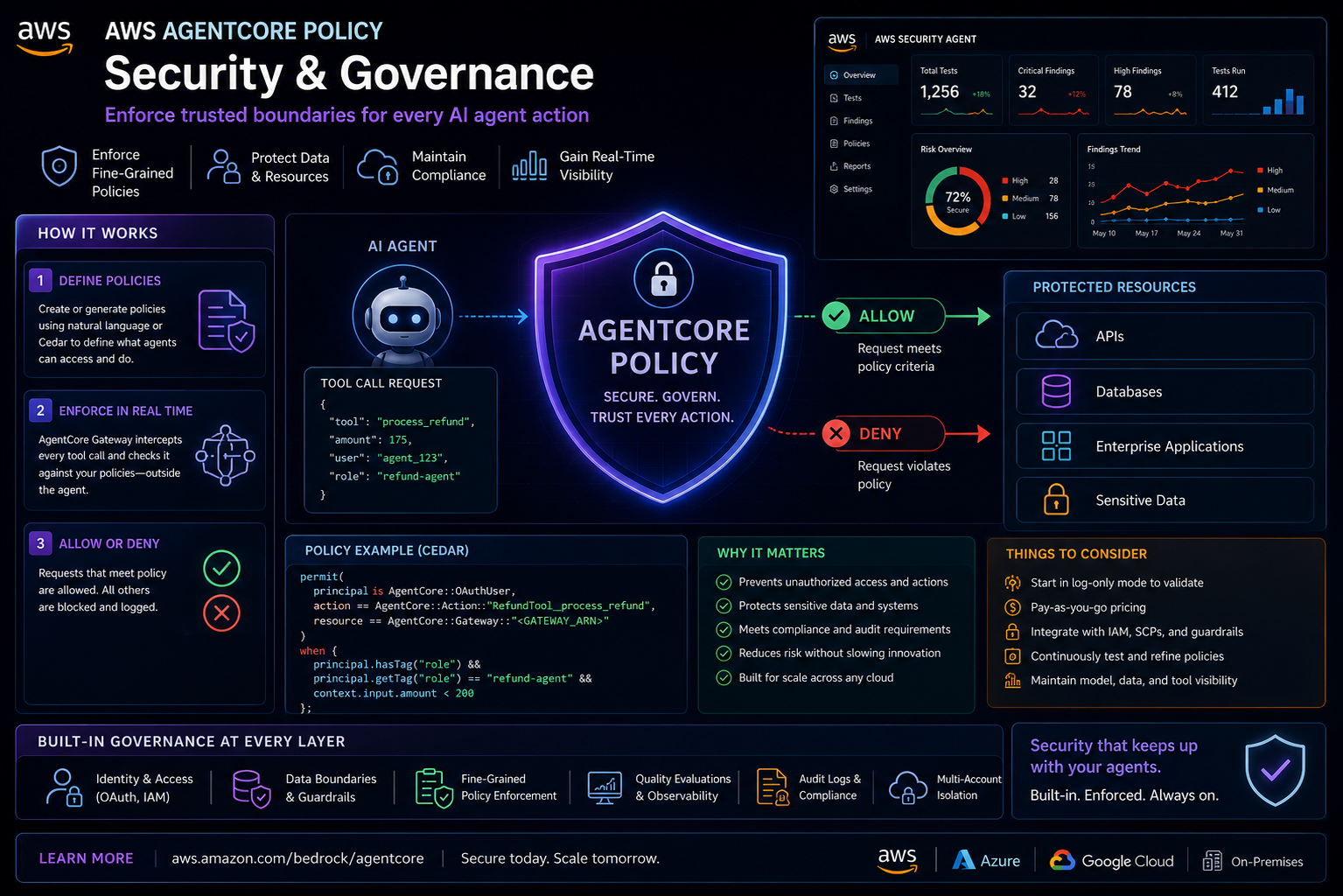
What makes this practical is how the rules get written. You can hand-write policies in Cedar , the open-source, fine-grained permissions language built for exactly this kind of authorization problem , or describe the rule in plain English and let the system generate, validate, and safety-check the Cedar policy for you. That second path means a compliance reviewer who has never touched Cedar can still author, read, and argue about a policy, without an engineer translating intent into code in the middle. The system understands the actual structure of the tool being governed, generates policies that are syntactically valid and semantically aligned with stated intent, and runs automated reasoning to catch conditions that are overly permissive, overly restrictive, or simply unsatisfiable. It's also available as an MCP server, so policy authoring can happen inside the same AI-assisted environment a team already uses.
Here's what a real policy looks like once compiled , this one restricts a refund tool to a specific role and caps the dollar amount, pulling both straight from the request context:
permit(
  principal is AgentCore::OAuthUser,
  action == AgentCore::Action::"RefundTool__process_refund",
  resource == AgentCore::Gateway::"<GATEWAY_ARN>"
)
when {
  principal.hasTag("role") &&
  principal.getTag("role") == "refund-agent" &&
  context.input.amount < 200
};
Notice what this doesn't depend on: which model the agent uses, how it was built, or what framework it runs on. It checks OAuth claims and the actual tool arguments, and either permits the call or it doesn't , the policy is a fact about the system, not a hope about the model. Before flipping a policy engine into enforcement mode, you can associate it with a Gateway in log-only mode first , validating what a policy would have blocked against real traffic before it starts blocking anything for real.
Governance as an Architectural Decision, Not a Checklist
Policy is the enforcement mechanism. AWS's AgentOps guidance frames it as one piece of a layered architecture where identity, data boundaries, memory, and account structure all have to agree before "authorized" means anything close to "safe."
Multi-account architecture as the foundation. Separate accounts for shared services, data governance, and application environments , dedicated dev, pre-prod, and prod per line of business, tagged for governance and cost tracking, deployed through Infrastructure as Code, with Service Control Policies setting guardrails across all of it. "Who can do what" stops being a policy document and becomes an architectural fact enforced by account boundaries.
Controlled model access. Which foundation models an application can reach is itself a governance decision, enforced through SCPs and IAM policies, often routed through a generative AI gateway that centralizes rate limiting, token budgeting, cost tracking, model routing by security policy, and audit trails. Gateway placement affects cost attribution , shared services is operationally simpler, but makes tracing spend back to individual agents harder.
Identity as the actual perimeter. AgentCore Identity manages inbound authentication (verifying the agent) and outbound authentication (its credentials to reach tools), so the agent itself never touches raw credentials. In multi-agent chains, cross-agent authentication has to maintain the same boundaries all the way down; if a limited-permission user triggers the first agent, those restrictions need to be inherited through every subsequent call. Identity establishes who you are and what you can touch; Policy answers the narrower question: are you allowed to do this specific thing right now.
Data governance. Every touchpoint , input, instructions, output, retrieved data, memory , is a place something can leak. Bedrock Guardrails checks prompts and responses against safety policies, catching things like inadvertent PII disclosure. Version-controlling evaluation datasets and tracking changes to RAG knowledge bases is what makes an audit trail reconstructable later, instead of a shrug and a guess.
Memory Governance, and Why Episodic Memory Changes the Calculus
Worth being precise about a distinction that's easy to blur: data is the underlying facts an agent queries, governed by traditional access controls. Memory is the agent's working context , what it retains about conversations and preferences. It's dynamic, and it needs its own governance model.
AgentCore Memory gives short-term and long-term memory with built-in extraction strategies. Namespaces organize memory by actor, session, or strategy, letting personalization and cross-user learning coexist without becoming the same thing by accident , memory scopes to the individual actor by default, and application-wide aggregation is a deliberate configuration choice, not an implicit one. Access to memory resources is controlled through IAM policies just like anything else, so two applications can share one memory resource while each keeps its own sensitive memory locked to itself.
This is exactly the surface episodic memory lands on. This new long-term memory strategy lets agents learn from past experiences and apply the lessons to future interactions , not just recalling facts, but recognizing patterns. The travel-booking example AWS uses: an agent that notices you consistently move flights later for client meetings will, over time, proactively suggest flexible return options next time. Enabling it means the system captures structured episodes , context, reasoning, actions, outcomes , and a reflection agent extracts broader patterns the agent can retrieve later, which also cuts prompt bloat by pulling in only what's relevant instead of front-loading every possible instruction.
Episodic memory means agents are now persisting inferred behavior, not just stated facts. It inherits the same namespace isolation and IAM-based access control as everything else , the right design, but worth verifying in your own configuration rather than assuming automatic. A memory resource correctly scoped for explicit preferences needs the same scrutiny once it starts accumulating inferred patterns.
Tool Governance: Where Gateway, Identity, and Policy Meet
Not every user should trigger every tool with every parameter , which is why Gateway, Identity, and Policy exist as three distinct layers instead of one permissions blob. Gateway turns APIs and services into MCP-compatible tools and defines which runtimes and backends an agent can reach at all, enforced by IAM and resource policies. Identity handles authentication at that boundary, inbound and outbound, so raw credentials never pass through agent code. Policy sits on top of both, intercepting the requests Gateway routes and evaluating them against Cedar rules , answering "are you allowed to do this right now," parameters checked, not just identity.
Three separate answers to three questions: what can this agent reach (Gateway), who is it authenticated as (Identity), is this specific action with these specific parameters permitted right now (Policy). Collapsing those into one layer is how "the agent had a valid token" and "the agent should have been allowed to do that" quietly become the same claim, when they're not.
Build & Operations
Governance is easy to treat as design-time , get the policies right, get identity right, ship it , but AWS's guidance treats build and operations as part of the same governance surface. Every agent, tool, and memory configuration is a versioned, deployable artifact with its own repository and CI/CD pipeline, separate from infrastructure and application repos. That's what lets you answer, with a straight face, which specific version of a tool was live when an incident happened.
In pre-production, evaluation explicitly includes authentication flows and authorization validation for tool access , verifying a user's identity and permissions actually propagate correctly across a multi-agent chain. On the tool side, registering a tool to the Gateway means defining a manifest specifying which Gateway it belongs to, its auth method, and its compliance metadata. On merge, the pipeline validates that manifest and registers the tool , under the hood, the CreateGatewayTarget and SynchronizeGatewayTargets calls doing the work:
# Illustrative pipeline step , not exact SDK syntax,
# just the shape of what happens on merge

gateway_client.create_gateway_target(
    gatewayIdentifier=GATEWAY_ARN,
    name="refund-tool",
    authMethod="oauth",
    compliance_metadata=manifest["compliance"]
)

gateway_client.synchronize_gateway_targets(
    gatewayIdentifier=GATEWAY_ARN
)
That's what turns "we agreed this tool needs an owner and an auth method" into something enforced automatically every time a tool ships. Every AgentCore Runtime deployment maintains immutable versions automatically, with endpoint aliases (DEV, PREPROD, PROD) pointing at specific versions , which is what makes instant rollback a genuine operational option rather than a manual, high-risk redeploy. A policy engine is only as trustworthy as the pipeline that deployed it; if tool registration and versioning aren't themselves gated, Policy and Identity are enforcing rules against a moving target.
What This Looks Like Stacked Together
Take a support agent with a refund tool. Identity confirms the agent's own credentials and the authenticated user's role via OAuth claims. Gateway defines that this agent can reach the refund tool and nothing outside its approved list. Policy intercepts the call and checks it against the Cedar rule , role has to be refund-agent, amount under $200 , regardless of how confidently the agent reasoned its way there. If episodic memory is enabled, the agent might recall this user tends toward complex refund conversations and adjust its approach , but that pattern lives in a namespace scoped to that actor, governed by the same IAM policy as every other memory resource. The entire configuration is a versioned artifact that went through CI/CD before reaching production.
None of these pieces is sufficient alone. Policy without Identity enforces rules against an unverified actor. Identity without Policy confirms who's asking without checking whether the request is reasonable. Memory governance without namespace isolation turns "the agent learned your preferences" into "the agent has a database of everyone's preferences with no boundaries." The value is in the stack, not any single layer.
Where This Still Needs Care
Policy in AgentCore is recent enough on the general availability side that most of the operational playbooks , how to test a policy engine's blast radius before trusting it at scale are still being written by the teams actually running it, not settled industry practice yet. Natural-language policy authoring is a strong way to bring people in early, but it's still worth having someone who reads Cedar review what gets generated, at least until a team has built up enough history to trust the automated safety checks on their own. Memory governance follows a similar pattern: namespace isolation and IAM controls are the documented model, but episodic memory is new enough that most teams haven't yet built the same review habits around inferred behavioral patterns that they already have around explicit data. That's less a gap in the platform than a gap in organizational habits still catching up to what the capability now allows.
The Takeaway
The honest version of "governance" for agentic systems isn't a document security signs off on once. It's an architecture where every layer , account structure, model access, identity, memory, tools, and the pipeline that deploys all of it , answers a narrow question and refuses to answer any other. AgentCore Policy gives that architecture real enforcement instead of a well-intentioned prompt, and the broader governance pattern around it keeps that enforcement from becoming the only thing standing between an agent and a mistake. Authorization was never the hard part. Controlled is.
References
- https://aws.amazon.com/blogs/aws/amazon-bedrock-agentcore-adds-quality-evaluations-and-policy-controls-for-deploying-trusted-ai-agents/
- https://aws.amazon.com/blogs/machine-learning/agentops-operationalize-agentic-ai-at-scale-with-amazon-bedrock-agentcore/
- https://aws.amazon.com/bedrock/agentcore/