



.png)
Blog by: Sidhartha Koneru | Fission Labs | 5 min read
Reinforcement fine-tuning (RFT) is becoming an important part of enterprise AI adoption. As organizations move beyond prompt engineering and supervised fine-tuning, they increasingly need models that can improve against business-specific quality signals correctness, helpfulness, tone, safety, formatting, and domain alignment.
For a long time, reinforcement learning-based fine-tuning was hard to pull off. Teams had to manage reward functions, rollout generation, model evaluation, distributed training infrastructure, experiment tracking, model artifacts, and deployment workflows.That complexity made RFT feel like a specialized ML engineering project rather than a practical customization path.
AWS is now changing that equation.Through Amazon SageMaker AI serverless customization and AmazonBedrock reinforcement fine-tuning, much of the operational burden has been shifted away from teams and onto the platform.
Based on our hands-on experience with both services, the biggest shift is clear: AWS lets you focus on the quality of your data, reward design, and evaluation strategy, not on wiring pipelines together.
For engineering and technology leaders, this shift changes more than tooling. It changes what it costs to get a model that meets your quality bar, in infrastructure, specialist headcount, and time to production. What used to require a dedicated ML engineering project is now a scoped workflow, which makes model customization a budget and roadmap conversation rather than a platform build.
Why Reinforcement Fine-Tuning Matters
Supervised fine-tuning teaches a model from examples. Reinforcement fine-tuning goes further by optimizing model behavior using feedback from a reward signal.
This matters when the desired output isn't a fixed answer, but a response that must satisfy certain quality criteria- criteria that can vary significantly by use case:
- A coding model can be rewarded when generated code passes tests.
- A math model can be rewarded when the final answer matches a verified result.
- A customer support or summarization model can be evaluated by a judge model using criteria like helpfulness, faithfulness, completeness, and tone.
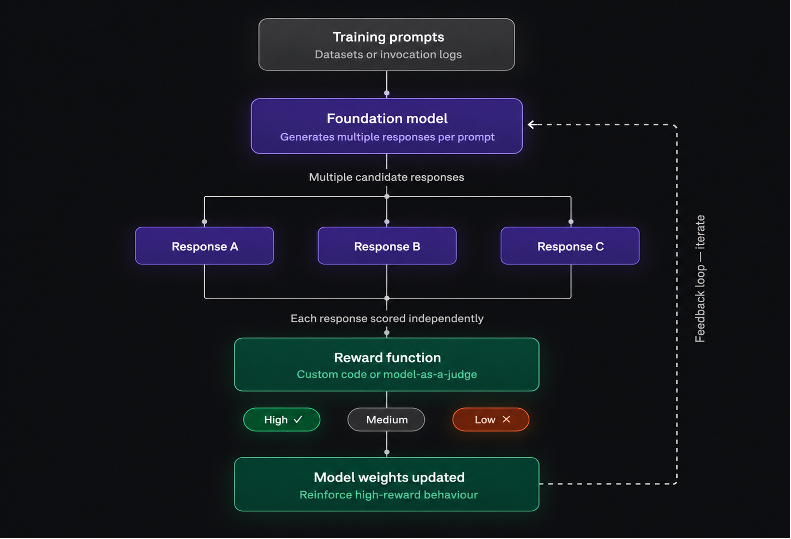
This makes reinforcement fine-tuning especially relevant for enterprise use cases where "good output"depends on business-specific expectations, not just benchmark performance.
What AWS Has Simplified
SageMaker AI
In our SageMaker AI evaluation, the customization workflow was available directly from the model card. The UI exposed multiple techniques in one place:
- Supervised fine-tuning
- Direct preference optimization (DPO)
- Reinforcement learning with verifiable rewards(RLVR)
- Reinforcement learning from AI feedback (RLAIF)
For RLVR, SageMaker AI surfaced built-in reward function options including exact match, code execution, and math answer verification. For RLAIF, it exposed reward model selection and reward prompt configuration - making reward setup a first-class part of the workflow, not buried in advanced settings.
We also found the guided dataset validation genuinely useful. The schema requirements for RL workflows are strict - fields like data_source, prompt, ability, reward_model, and extra_info all need to be present and correctly formatted. The UI surfaced missing fields clearly, which saved meaningful debugging time. AWS has simplified the workflow, but dataset preparation still requires care.
Amazon Bedrock
Bedrock provides a similarly managed approach. Job setup in Bedrock covered the full lifecycle: model selection,input data configuration, reward behavior definition, hyperparameter tuning,training monitoring, and deployment, all in one guided flow.
One standout capability is the ability to use invocation logs in addition to datasets from Amazon S3. For many enterprise teams, this is a practical starting point: historical prompts and model interactions you already have can become the raw material for model improvement.
Bedrock also supports flexible reward configuration - either through custom code (when the task can be objectively verified) or model-as-a-judge evaluation (when the task is subjective and scoring criteria need to be defined in natural language). To make setup faster, Bedrock provides preloaded reward templates that can be edited and passed directly to the judge model, so you're not starting from scratch every time.
Once a job is running, Bedrock surfaces training stages and real-time metrics, giving teams meaningful visibility into how the reinforcement learning process is progressing, not just a status indicator.
What Worked Well
The biggest win across both services is ease of launch. Reinforcement fine-tuning no longer starts with provisioning infrastructure, configuring training clusters, or manually wiring together tracking and deployment systems.
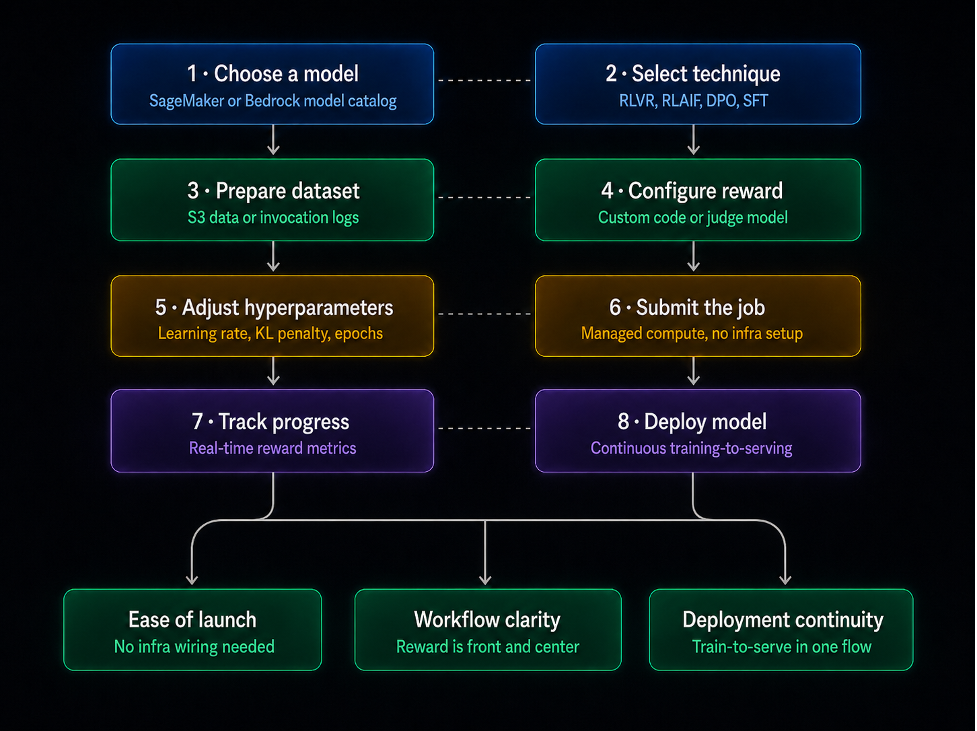
The workflow is now much more guided:
This dramatically lowers the barrier for teams that want to explore reinforcement fine-tuning without first building a full RL training platform.
Workflow clarity. Both SageMaker AI and Bedrock make reward configuration a visible, central part of the process. This matters because reinforcement fine-tuning isn't just another fine-tuning option, the reward signal is the method.
Deployment continuity. After customization, the model can move toward production without requiring a separate handoff from training infrastructure to serving infrastructure.
Where Expertise Is Still Needed
AWS has made reinforcement fine-tuning easier to start. But success still depends on the quality of the implementation.
Reward design is the most critical area. A weak reward function or an unclear judge prompt can push the model toward the wrong behavior. For enterprise use cases, the reward criteria must accurately reflect your business definition of quality, not just a generic approximation.
Dataset preparation remains non-trivial. RL workflows are more sensitive to structure and metadata than basic supervised examples. The dataset must match the selected technique and include required fields in the expected format.
Evaluation is equally important. A completed training job doesn't automatically mean the model improved. The customized model should be compared against the base model using task-specific test cases, quality metrics, human review where appropriate, and production-style scenarios.
Cost planning also matters. Reinforcement fine-tuning can be less predictable than supervised fine-tuning, jobs may involve rollouts, reward model evaluation, and multiple generated responses per prompt. Start with a limited-scope evaluation before scaling to larger datasets or production workflows.
Our Perspective
Our hands-on work with both services points to a clear shift: AWS is making reinforcement fine-tuning genuinely practical for enterprise teams.
Previously, the complexity of RL-based customization was concentrated in infrastructure, orchestration, and pipelinesetup. With SageMaker AI and Bedrock, much of that operational burden is now managed by AWS.
This allows teams to focus on the questions that actually create business value:
- What behavior are we trying to improve?
- Can the task be verified programmatically, or do we need a judge model?
- Do we have useful historical prompts or invocation logs?
- How should the reward criteria be defined?
- How will we compare the customized model with the base model?
- What's the right deployment path?
These are the questions that determine whether reinforcement fine-tuning delivers real results.
In our experience, answering them well is where most teams need a structured starting point. Use case discovery, feasibility, and evaluation criteria should be settled before any training job is launched, not after.
The Bottom Line
Reinforcement fine-tuning used to be difficult because it required specialized infrastructure, reward pipelines, tracking, and deployment engineering. AWS is changing that through guided, managed workflows in SageMaker AI and Amazon Bedrock.
Our experience shows the workflow is becoming significantly easier to launch and operate. But the real success of reinforcement fine-tuning still depends on thoughtful reward design, clean datasets, strong evaluation, and the right deployment strategy.
For enterprises, that's the real opportunity: AWS lowers the operational barrier, while expert AI engineering turns the workflow into measurable model improvement.
If you are exploring where reinforcement fine-tuning or broader model customization fits in your AI roadmap, our GenAI Launchpad is a practical place to start.

It offers 40 hours of free consulting for qualified teams, giving you room to work through use case selection, feasibility, and evaluation strategy with our AI engineers before committing to a training effort. If working through these questions together sounds useful, reach out and we will set up a conversation.
Blog References
- https://docs.aws.amazon.com/bedrock/latest/userguide/reinforcement-fine-tuning.html
- https://aws.amazon.com/about-aws/whats-new/2025/12/bedrock-reinforcement-fine-tuning-66-base-models
- https://docs.aws.amazon.com/sagemaker/latest/dg/customize-model.html
- https://builder.aws.com/content/3BSCNGW7LDrccc0KQCjCNpxEF8o/serverless-model-customization-in-amazon-sagemaker-ai
- https://aws.amazon.com/blogs/machine-learning/reinforcement-fine-tuning-on-amazon-bedrock-with-openai-compatible-apis-a-technical-walkthrough